
‘The Devils’ Return
Ken Russell’s exorcised masterpiece comes back from the cinematic underworld

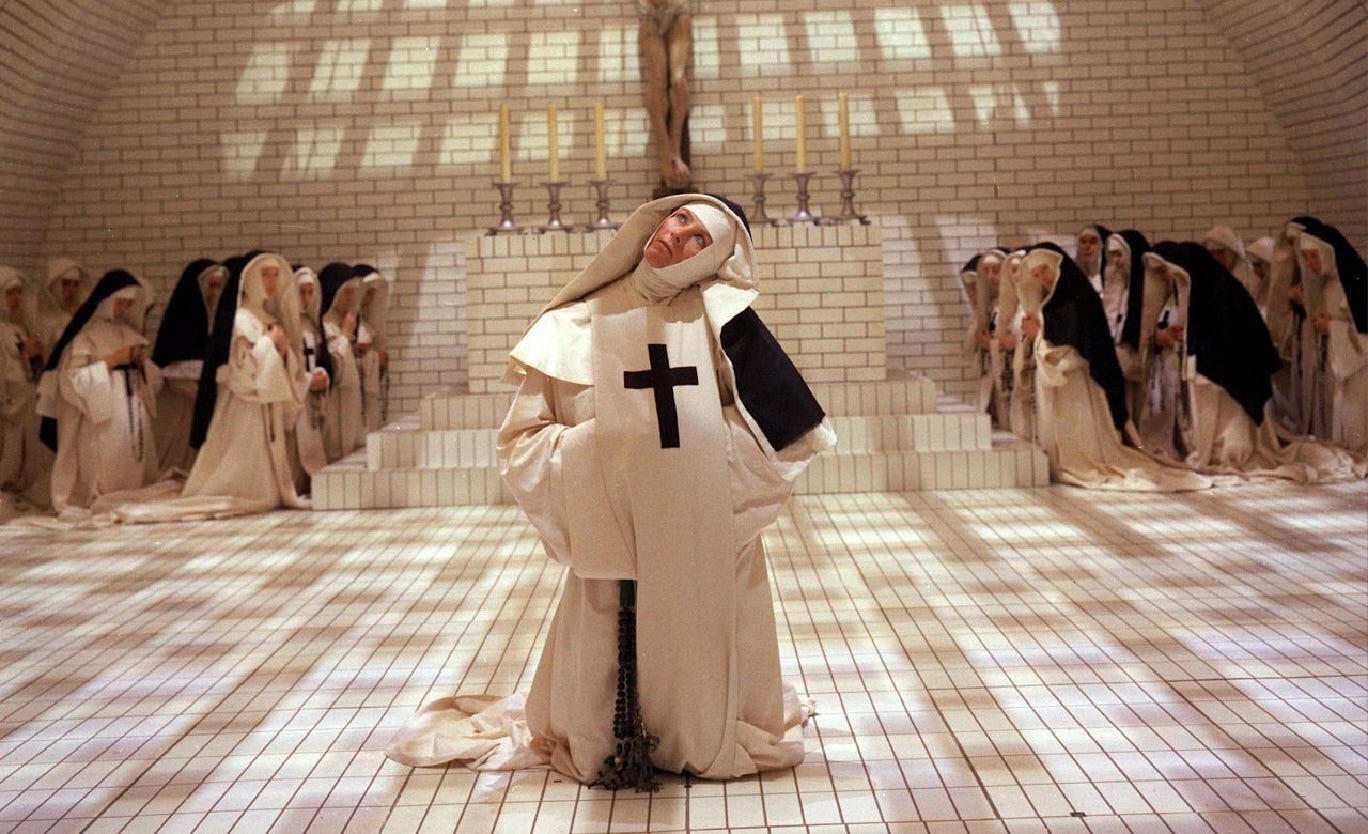
The strange thing about cinematic exorcisms is that they rarely hold forever.
For decades, Ken Russell’s The Devils existed in a kind of studio purgatory: too famous to disappear completely, too radioactive for Warner Bros. to embrace openly, passed among cinephiles in damaged tapes and compromised cuts like contraband from a fallen civilization.
Now it arrives at Cannes Classics in restored form as the 2026 Cannes Film Festival gets underway this week, officially welcomed back into the canon by the same corporate culture that once seemed eager to bury it.
Which feels oddly appropriate for a Ken Russell movie.
Russell never understood moderation as either an artistic principle or a survival skill. Even among the great cinematic provocateurs of the late 1960s and early ’70s — Kubrick, Peckinpah, Pasolini, Roeg — he seemed uniquely incapable of leaving an image alone once he found it. Other directors implied excess. Russell staged it with marching bands, screaming nuns, collapsing institutions and enough religious hysteria to make medieval Europe look under-rehearsed.
Critics spent years treating him as a talented vulgarian, too gaudy for seriousness, too emotional for intellectual respectability. Which now seems partly like a category error. Before becoming Britain’s cinematic ringmaster of excess, Russell emerged from BBC arts-documentary television, directing films about composers and artists that already displayed the tendencies that would later scandalize audiences: dream imagery, emotional subjectivity, aggressive stylization, a refusal to keep intellect and sensation politely separated.
The Devils became the ultimate expression of those instincts.
I first saw it decades ago under conditions that now feel appropriate to the movie itself: imperfectly, half-whispered about, carrying the faint aura of forbidden material. Somebody always seemed to know somebody who had a tape. The image quality looked diseased. Colors bled into one another. Whole scenes appeared swallowed by darkness or analog snow.
Which, honestly, may have intensified the experience.
The movie already feels like civilization decomposing in public.
As the 2026 Cannes Film Festival heads into its final weekend, one of the most talked-about resurrection stories in Cannes Classics has not involved some neglected silent masterpiece or respectable art-house rediscovery. It has involved Ken Russell’s The Devils, returning officially — or as officially as a film like this can return — in a restored version screening at the festival just before Cannes wraps May 23. Warner Bros., the same studio that once treated the film like radioactive waste sealed beneath concrete, is now presenting it as part of its cinematic heritage.
History eventually catches up even with exorcised films.
Or perhaps especially with exorcised films.
Seeing It Wrong
I first saw The Devils decades ago under conditions that now feel appropriate to the movie itself: imperfectly, half-whispered about, carrying the faint aura of forbidden material. Somebody always seemed to know somebody who had a tape. The image quality looked diseased. Colors bled into one another. Whole scenes appeared swallowed by darkness or analog snow. Which, honestly, may have intensified the experience. The movie already feels like civilization decomposing in public.
Watching it was one of the most disturbing experiences I have ever had in a theater.
Not because it is merely shocking. We tend to overestimate how shocking older controversial movies remain once time and the internet have flattened everybody’s thresholds. Younger audiences raised on livestreamed disasters, cartel footage, algorithmic pornography and permanent outrage culture are unlikely to faint at blasphemy or nudity.
No, what remains disturbing about The Devils is something deeper and more structural. The movie understands how hysteria works institutionally — how crowds become audiences for punishment, how bureaucracies convert appetite into morality and morality into spectacle.
Most films about madness eventually reassure us that the madness is exceptional.
The Devils suggests the opposite.
That distinction may explain why the film still produces a strange recoil even among experienced cinephiles. Plenty of transgressive movies eventually mellow into cult comfort food. The Rocky Horror Picture Show became participatory comedy. Even A Clockwork Orange, once treated as civilization-threatening, now feels partly absorbed into pop iconography: bowler hats, fake eyelashes, Malcolm McDowell sneering from dorm-room posters.
The Devils never entirely made that transition.
Or rather, it resisted it.
Stanley Kubrick’s A Clockwork Orange, released the same year, scandalized audiences with ultraviolence and sexual sadism, but Kubrick’s precision imposed a kind of aesthetic control over the nightmare. The movie’s symmetrical compositions and icy wit create critical distance. You always feel Kubrick standing above the material like a scientist observing moral collapse through reinforced glass.
Russell does not stand above anything.
His movies plunge directly into contamination. Watching The Devils feels less like observing hysteria than contracting it.
Loudun
The film, loosely adapted from Aldous Huxley’s The Devils of Loudun, concerns the historical 17th-century case of Urbain Grandier, a French priest accused of witchcraft after a convent of Ursuline nuns claimed demonic possession. Oliver Reed plays Grandier with dangerous charisma: sensual, vain, intelligent, theatrical, too aware of his own magnetism. Vanessa Redgrave plays Sister Jeanne, the physically deformed Mother Superior whose sexual obsession with Grandier metastasizes into accusation, fantasy and eventually catastrophe.
Already this sounds lurid enough.
But Russell’s great achievement — or act of assault, depending on your tolerance for cinematic extremity — was understanding that the Loudun possessions were not fundamentally about demons. They were about systems. Cardinal Richelieu wants to consolidate power in France by eliminating fortified cities capable of independent resistance. Loudun’s walls become politically inconvenient. Grandier opposes their destruction. Therefore Grandier must become morally impossible.
That is the engine.
The possessions are useful.
One of the things that makes The Devils feel so contemporary now is the way the film depicts accusation acquiring momentum independent of evidence. Everybody inside the machinery gets something from the process. Sister Jeanne gets erotic fixation disguised as righteousness. The exorcists receive authority and public visibility. Political officials receive administrative justification. Crowds receive spectacle. The monarchy receives obedience. Nobody has to invent the hysteria entirely. They merely have to direct it.
Russell stages all this less like historical drama than like a nervous breakdown mounted by Busby Berkeley.
Derek Jarman’s production design remains astonishing: Loudun rendered as a white modernist fortress of corridors, arches and sterile geometries. Most historical films attempt texture. Russell and Jarman pursue abstraction. The city looks less like 17th-century France than like a fascist cathedral designed by a brutalist architect on speed.
Everything gleams with accusation.
The whiteness matters. White walls. White stone. White light. White costumes. It creates the sensation that bodies themselves have become stains. Sin in “The Devils” is not hidden beneath surfaces. It is projected onto them.
Ken Russell’s Beautiful Vulgarity
Critics spent years treating Russell as a vulgarian — talented but hysterical, too gaudy for seriousness. Which now seems partly like a category error.
Before becoming Britain’s great cinematic ringmaster of excess, Russell emerged from BBC arts-documentary television. His early profiles of composers and artists already displayed the tendencies that would later scandalize critics: dream imagery, emotional subjectivity, aggressive stylization, a refusal to keep intellect and sensation politely separated.
He understood something many respectable filmmakers avoid: institutions are theatrical. Power is theatrical. Religion is theatrical. Politics is theatrical. Even righteousness is theatrical.
And hysteria has choreography.
The exorcism scenes remain almost uniquely upsetting because they refuse tasteful separation between sexuality, performance, humiliation and mass entertainment. The possessed nuns howl, moan, claw at themselves, convulse against religious statuary while crowds gather as though attending carnival attractions.
Which, in a sense, they are.
Russell understood the hidden entertainment economy inside moral panic.
One watches these scenes now and thinks not merely of historical witch hunts but of cable news panels, social-media pile-ons, public shaming rituals and the modern internet’s infinite appetite for collective denunciation.
The possessed body becomes content.
That is partly why the movie still feels dangerous. It implicates the viewer. The audience inside The Devils — the crowds laughing, gawking, salivating over punishment — are not safely historical peasants behaving badly in another century. They are us.
Oliver Reed: Appetite and Martyrdom
Oliver Reed’s performance anchors the chaos by refusing saintliness. Grandier is no innocent martyr in the conventional sense. He sleeps with women. He enjoys admiration. He weaponizes charm. Reed plays him with a kind of reckless masculine vitality that borders on arrogance.
Which makes the film’s trajectory more complicated and far more moving.
Grandier becomes moral almost accidentally. The machinery surrounding him becomes so corrupt, so grotesque, so ravenously dishonest that his refusal to confess transforms him into something resembling integrity.
Reed was one of the few actors physically capable of surviving Russell’s cinema. He possessed that rare combination of brute force and wounded intelligence. British cinema spent years trying to figure out what exactly to do with him. He looked like a rugby enforcer who had somehow wandered into Shakespeare.
By the early 1970s, Reed had already acquired a reputation for offscreen chaos nearly as legendary as his onscreen presence: bar fights, talk-show disasters, drinking stories that grew increasingly difficult to separate from folklore. Yet what often gets lost beneath the mythology is how technically precise he could be.
Early in The Devils, Reed strides through Loudun with black-clad confidence, radiating appetite. By the end, the body itself has become contested territory: tortured, broken, humiliated, burned.
Yet Reed never lets Grandier become abstract martyrdom. Fear remains visible. So does vanity. So does anger.
Watching the film now, one realizes how unusual Reed’s movie-star energy actually was. Modern actors often signal danger while remaining fundamentally careful. Reed feels genuinely unstable in the old-fashioned sense — not psychologically unsafe, but physically unpredictable, as though the performance itself might break containment.
That quality becomes essential in The Devils. Grandier has to seem charismatic enough to inspire obsession while remaining flawed enough to attract resentment. Reed gives the movie its combustible center.
Vanessa Redgrave and the Possessed Interior
Vanessa Redgrave may be even better.
Her Sister Jeanne is grotesque, pitiable, manipulative, erotic, pathetic and terrifying all at once. The performance refuses simplification. Jeanne’s physical deformity and emotional repression curdle into fantasy, then into public accusation. But Redgrave never plays her merely as villain or victim.
She is a woman trapped inside structures that have converted desire into pathology.
What makes the performance so unnerving is its emotional nakedness. Redgrave was already emerging as one of the great actresses of her generation — intellectually formidable, politically outspoken, willing to appear emotionally unguarded onscreen in ways many stars avoided.
In lesser hands, Jeanne could easily become camp grotesquerie. Redgrave instead turns her into the movie’s emotional wound.
One of the most unsettling things about The Devils is that the actual supernatural question becomes almost irrelevant. Russell does not especially care whether demons exist. Institutional evil proves sufficient.
The Film Warner Bros. Tried to Forget
The film’s most notorious sequences — including the long-suppressed “Rape of Christ” scene involving desecration inside the convent — generated decades of censorship battles and studio panic. Warner Bros. repeatedly distanced itself from the movie. Critics denounced it as sacrilegious pornography masquerading as art.
The reaction now feels revealing in its own right.
American critics in the early 1970s could often accommodate violence more easily than blasphemy. The Godfather arrived the following year. Dirty Harry became a mainstream hit. But Russell fused sex, religion, politics and institutional corruption in ways that destabilized the categories audiences used to organize moral response.
The film arrived during a strange historical overlap: post-1960s counterculture, collapsing deference toward authority, expanding cinematic freedom and lingering cultural panic about obscenity all colliding simultaneously.
Yet the real blasphemy in The Devils is administrative.
The torture scenes are horrifying not because Russell fetishizes pain but because he depicts cruelty becoming procedural. Forms get signed. Officials confer. Clergy rationalize. Public executions proceed with bureaucratic rhythm. One of the movie’s deepest insights is that atrocities often arrive wearing the expression of management.
Which may explain why the film seems more resonant now than it did in 1971.
Back then, audiences focused heavily on the transgressive imagery: the naked nuns, the sexual frenzy, the desecration. Today those elements feel almost secondary to the film’s anatomy of institutional manipulation. The movie now plays less like blasphemy than prophecy.
We live in a culture permanently suspended between outrage and entertainment. Public morality increasingly behaves like competitive performance. Social-media algorithms reward denunciation. Institutions discover strategic uses for panic. Crowds gather digitally instead of physically, but the emotional mechanics remain eerily similar.
Russell’s Loudun now feels less remote than diagnostic.
Sister Jeanne Enters the Serververse
The strangest aftershock arrived a few years ago inside Space Jam: A New Legacy.
Buried somewhere inside the film’s intellectual-property mosh pit of superheroes, cartoon animals, science-fiction franchises and Warner Bros. legacy characters, I suddenly noticed the nuns from The Devils. Not generic movie nuns. Not vaguely Gothic background figures. The actual screaming, sexually convulsed Ursuline nuns from one of the most infamous films ever released by a major Hollywood studio.
And maybe that is why the cameo rattled me so deeply.
Because the figure wandering through that digital corporate pageant did not merely resemble one of the anonymous possessed nuns from The Devils. It appeared to be Sister Jeanne herself — Vanessa Redgrave’s sexually tormented Mother Superior, one of the most psychologically ruptured characters in 1970s cinema, reduced half a century later to background Warner Bros. inventory.
Which somehow makes the whole thing even stranger.
Sister Jeanne is not Dracula or Pennywise or even one of the droogs from “A Clockwork Orange.” She is not an easily marketable icon. She is the emotional wound at the center of Russell’s movie — a woman so deformed by repression, desire and institutional manipulation that she eventually helps destroy the object of her obsession.
Yet there she was in Space Jam, drifting through the crowd like an escaped hallucination from another era of filmmaking.
The image now feels almost accidentally profound. Jeanne spends The Devils trapped inside a spectacle engineered by church and state, only to reappear decades later absorbed into another enormous corporate spectacle built from recognizable intellectual property.
Warner Bros. had finally figured out how to metabolize The Devils. Not by resolving the controversy or defending the film artistically, but by converting it into reusable mythology. Once the nuns became recognizable assets inside the Warner intellectual-property ecosystem, restoration suddenly became possible.
There is something perversely fitting about that. The Devils itself is partly about institutions absorbing dangerous energies and repurposing them for power. Half a century later, the scandal ages into heritage.
And yet the movie stubbornly resists domestication.
Even now, discussing The Devils in polite company produces a strange recoil. People lower their voices. They describe it as “a lot.” They laugh nervously before recommending it. It retains the aura of something not entirely housebroken.
Part of that comes from Russell’s refusal of tasteful distance. Modern prestige cinema often aestheticizes atrocity into mournful elegance. Russell does the opposite. He makes ugliness feel contaminating. Watching The Devils can feel less like viewing a movie than surviving an infection.
Cannes and the Canon
Which raises an interesting question as Cannes moves toward its closing ceremonies this weekend.
Cannes Classics increasingly functions as a kind of official canonization machine. Films screened there are not merely restored. They are institutionally certified as important. The festival effectively announces: this belongs to cinema history.
But what does it mean when the establishment finally embraces a movie dedicated to exposing the corruption of establishments?
Perhaps enough time has passed for the danger to seem historical.
Or perhaps the opposite is true: the culture now recognizes that Russell saw something coming.
Watching The Devils today, one becomes aware how many later filmmakers borrowed fragments of its nervous system. You can feel echoes in Andrzej Żuławski’s Possession, in the sacred grotesquerie of Darren Aronofsky, in the institutional horror of Chernobyl, in the collision between sex, violence and religious imagery that runs through so much modern prestige horror.
Russell anticipated an age when spectacle itself would become governance.
And maybe that is why the movie lingers.
Not because of the blasphemy.
Not because of the naked nuns.
Not even because of the violence.
The Devils lingers because it understands something terrible about civilization: people often prefer performance to truth. Especially when the performance flatters their righteousness.
The crowds in Loudun do not merely tolerate the destruction of Grandier. They participate emotionally in it. The exorcisms give them narrative clarity, erotic excitement, communal identity and moral superiority all at once.
The devil, Russell suggests, is not hidden somewhere outside the walls.
The devil is the crowd’s appetite for certainty.
And the truly unsettling thing — the thing that made “The Devils” one of the most disturbing experiences I have ever had at the movies — is the creeping realization that Russell does not exempt us from the diagnosis.
We arrive expecting horror.
Then slowly recognize ourselves in the audience.
I saw The Devils in 1971 at what I remember as an art house in Memphis. The ahistorical clean-shaven Richelieu and Louis XIII; the all-but-nude monarch in the court masque (did Russell incorporate the king’s baroque blackbird composition?); the horrific Sister Jeanne; the in-your-face naked nuns; and the burning, decomposing flesh of Grandier all seemed of an inescapable piece. This was no Women in Love observed at an aesthetic distance. There was no campy Droogy ultraviolence nor bizarre Polanski post-Manson Scottish-play excess. I remember my twenty-one-year-old self feeling consumed by Russell’s Devils, dragged with revulsion but without resistance into layer after layer of decadence. Shortly after seeing the film, I found a trade-paperback of Huxley’s Devils of Loudon and read it, hoping to make historical sense of my experience. Nothing helped. Perhaps the restored film will.