
Review: ‘Sentimental Value’

Sentimental Value begins at a funeral, the mother’s, and with a house that seems to have absorbed more of the family’s history than any of its occupants ever managed to articulate. The Oslo home, with its narrow hallways and uneven light, becomes a kind of emotional repository—rooms that recall the years when the family was intact, stairs that remember arguments the daughters no longer mention. It’s a striking choice: the house witnesses the story as much as the people who inhabit it.
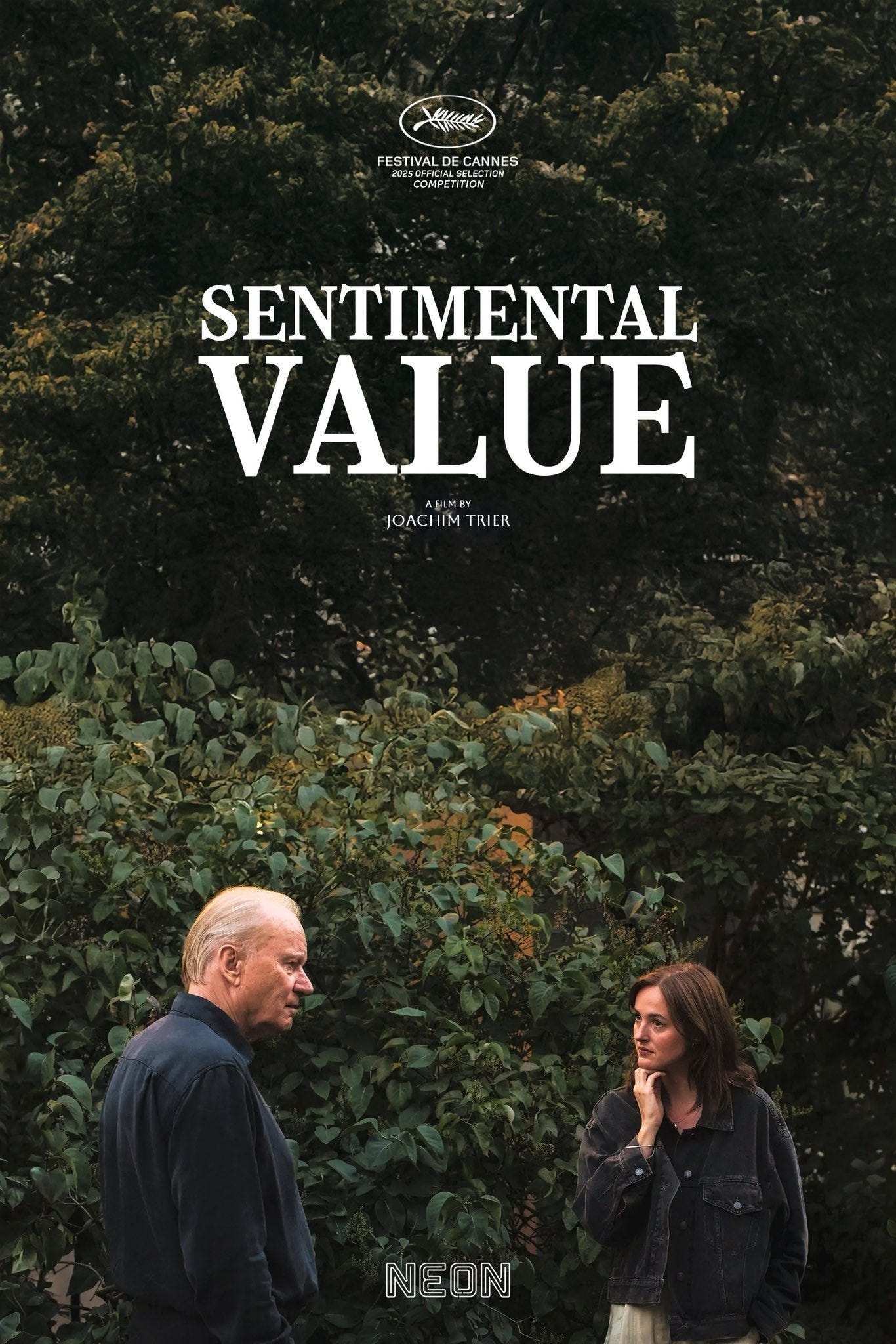
Nora and Agnes, the two Borg sisters, have grown in different directions. Nora has built a life around the stage and screen—she moves through the world with the practiced alertness of someone who has learned to turn emotion into craft. Agnes has chosen steadier rhythms, a family, a child, routines that offer shape but not necessarily comfort. Both paths feel true, and both seem to carry the imprint of a childhood punctured by long absences.
Their father, Gustav, returns with a proposal: a new film, his first in years, drawn from the life of the grandmother—a woman who endured harrowing history and whose death casts a long shadow over the family. Gustav wants Nora to play the lead. She refuses. He moves on and casts a young American actress, Rachel Kemp, whose presence subtly shifts the emotional temperature. No one erupts; rather, the air changes. Scenes feel slightly off-balance. The daughters recalibrate without speaking about it.
From here, the film proceeds through small pressures rather than confrontations. The father prepares his film on the family property. The daughters drift in and out of his orbit. A script reading doubles as a partial reckoning. A dinner scene tells you more through its silences than its dialogue. Nothing resolves outright; everything shifts a degree or two at a time.
This is where the comparison to The Worst Person in the World becomes interesting. That earlier film pulsed with momentum, tracing a young woman’s attempts to locate herself amid the flux of work, romance and identity. Sentimental Value works in the opposite direction: the characters already know who they are, and the drama comes from living with that knowledge. The earlier film danced; this one listens.
Renate Reinsve brings a quieted ferocity to Nora. She embodies a woman who understands her own emotional circuitry so well that she rarely lets anyone near the switchboard. Her performance is internal, built from glances, withheld impulses, the way she stands slightly away from the people she loves most. Nora isn’t guarded out of fear—she’s guarded out of long experience. Reinsve makes every scene feel like an echo chamber: you hear the sound of old decisions reverberating inside her.
Stellan Skarsgård, as Gustav, plays a man who regards his own failures with an artist’s ambivalence—half regret, half material. He doesn’t plead for forgiveness, nor does he deny the damage. Instead, he moves through the film with a weight that seems to have settled in his bones. His conversations with his daughters feel shaped by older versions of himself, versions he can’t quite discard. The performance is remarkable for how little it insists on itself.
Inga Ibsdotter Lilleaas, as Agnes, provides the film’s stabilizing force, though her version of stability is complicated. She has built a life that, from the outside, seems orderly, but the film lets us see how carefully that order is maintained. Lilleaas conveys the tension of someone who has learned to keep the peace but is not unaware of what that costs her. She listens more than she speaks, and it’s in the listening that her emotional intelligence becomes visible.
The film within the film—Gustav’s project about the grandmother—acts as a mirror rather than a gimmick. As he tries to reconstruct a trauma he barely understands, his daughters watch him fumble with a legacy that still shapes them. The set on the family grounds, the scenes reenacted in rooms haunted by their own memories, the script revised to suit a narrative that never quite fits: all of it becomes a study in how families tell stories about themselves, and what those stories leave out.
Joachim Trier avoids melodrama entirely. He trusts the audience to follow the faint currents beneath the surfaces. In a lesser film, the return of the estranged father would spark a catharsis. Here, it sparks attention—attention to what is said, what is not said, what is quietly endured. The film’s emotional power comes from the way it asks its characters to inhabit the same space without dictating what they should do with that proximity.
Compared to The Worst Person in the World, Sentimental Value is gentler, more weathered, more attuned to the histories adults carry. It’s a film about the shape of inheritance—emotional, artistic, familial—and how those inheritances refuse to stay in the past. No one in this story is judged. No one is absolved. Instead, Trier offers an environment in which recognition becomes its own form of movement.
The performances give the film its inner glow. They carry the weight without announcing it. They make the house feel alive with old vibrations. They make the silences dense enough to lean against.
Sentimental Value is Trier at his most understated—and perhaps his most perceptive. It’s a film that doesn’t proclaim anything. It simply reveals.
Cast
Renate Reinsve as Nora Borg
Stellan Skarsgård as Gustav Borg
Inga Ibsdotter Lilleaas as Agnes Borg Pettersen
Elle Fanning as Rachel Kemp
Anders Danielsen Lie as Jakob
Lena Endre as Ingrid
Jesper Christensen as Michael
Major Crew
Director: Joachim Trier
Screenwriters: Joachim Trier & Eskil Vogt
Producers: Maria Ekerhovd & Andrea Berentsen Ottmar
Cinematography: Kasper Tuxen
Editor: Olivier Bugge Coutté
Music/Score: Hania Rani