
Buddy Flett, R.I.P.

I always wanted to be in a band with Buddy Flett. He was one of the most tasteful guitar players I’ve ever known.
Not the flashiest. Not the loudest. Not one of those players who seemed to regard every song as an excuse to dump their toolbox onthe floor. Buddy understood something harder and ultimately more enduring: restraint. He knew how to leave room inside a song. He knew that tone could carry emotion more effectively than speed, and that one perfectly placed note could say more than a hundred frantic ones.
That kind of playing is rarer than people think.
Buddy belonged to that deep Southern musical tradition where musicians learned not just from records but from rooms — bars, dance halls, clubs, late-night rehearsals, half-broken stages and long drives between gigs. You could hear north Louisiana in his guitar playing. There was swamp blues in it, Memphis soul in it, country sorrow in it, rock-and-roll looseness in it. Shreveport was in there too: the old Louisiana Hayride ghosts, the strange crossroads where American music once mixed freely before corporations began sorting everything into marketing categories.
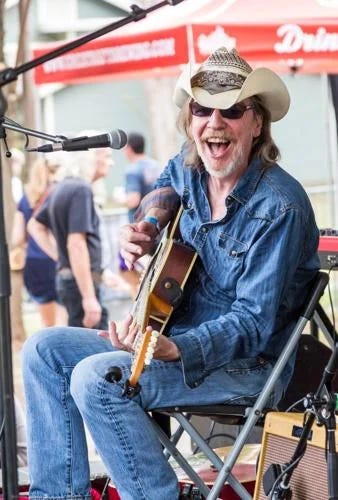
He played like somebody who loved songs more than solos.
That may sound like a small distinction, but it explains almost everything about Buddy Flett.
There are musicians who play at you, and musicians who play for the music itself. Buddy always seemed to understand that a band was a conversation, not a contest. His guitar parts listened as much as they spoke. Even his solos felt collaborative, woven into the song rather than dropped on top of it like a flag planted after conquest.
And because of that, musicians trusted him.
I met him in the late ’70s, and though we never hung out much I thought of him as a friend. We had a rapport that might have been easier had I not been quite so awed by his talent. I remember interviewing him in the early ’80s, after he’s bought a house, when A Train was flourishing. He was making the equivalent of a teacher’s salary from his music. He was so damn happy.
About a year ago I ran into him, in the company of my buddy Dave Hoffpauir, at the local Guitar Center. Buddy had found a cheap guitar he thought he might be able to work with, but he didn’t want to pay retail. We had a brief conversation. I never dreamed it would be our last.
The people who knew Buddy best tend to talk less about virtuosity than feel. Taste. Pocket. Warmth. Those qualities are harder to quantify and harder still to teach. Plenty of musicians can learn scales. Very few learn wisdom. Buddy had wisdom in his playing. He understood pacing. He understood tension. He understood the emotional architecture of American roots music in a way that cannot really be learned from diagrams or YouTube tutorials.
In another world — a kinder, more generous world — Buddy might have become vastly more famous. But there was something beautifully regional about him, beautifully human-scale. His reputation traveled the old-fashioned way: musician to musician, club to club, recommendation to recommendation. The people who knew, knew.
And they knew he was the real thing.
What I’ll remember most is the generosity in the music. Buddy’s guitar never sounded vain. Even at its bluesiest or most melancholy, there was companionship in it. The songs never felt lonely because the player himself never sounded emotionally distant from the people listening. His guitar lines seemed to reach toward people rather than away from them.
That may be why his loss feels larger than a single musician’s death.
People like Buddy Flett carried entire traditions forward without making a fuss about it. They kept regional music alive not as museum culture but as living conversation. They reminded us that American music was built not only by stars but by working musicians — the road players, the sidemen, the local legends, the guys whose names may never dominate streaming algorithms but whose fingerprints end up all over the culture anyway.
Buddy was one of those custodians.
Somewhere tonight, somebody in Louisiana is still playing one of those Buddy licks. Some young guitarist is learning that taste matters more than volume. Some bar band is discovering that the spaces between notes can carry their own kind of truth. And somewhere in all of that — in the feel, the restraint, the soulfulness, the deep Southern ache of it — Buddy Flett is still present.
Thank you- so well said. One of my joys of being back in Shreveport was being able to listen to Buddy regularly. My heart is broken.